
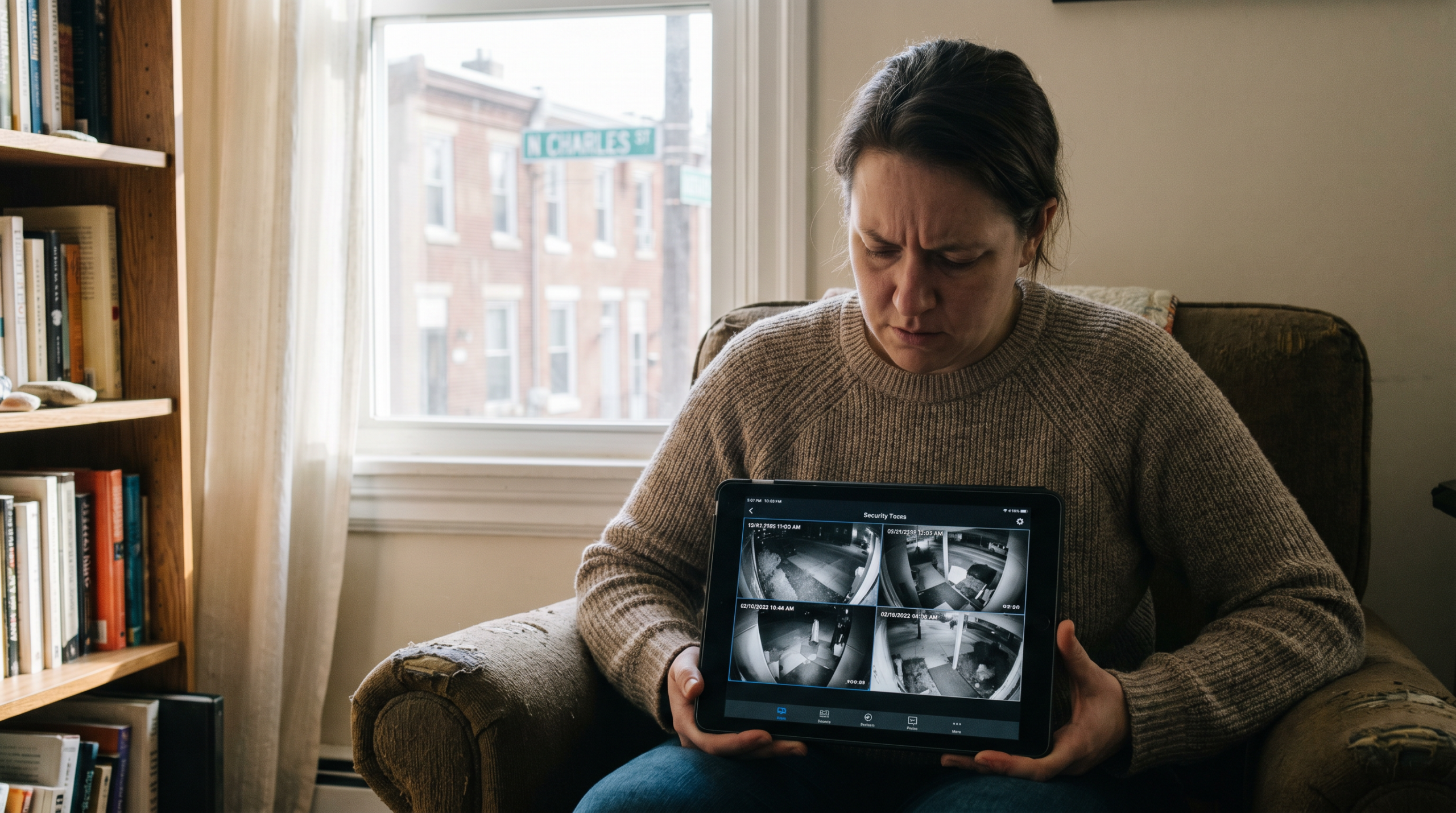
The High Stakes of Baltimore Surveillance: Safety vs. Statute
Baltimore residents aren’t wrong to want security cameras. With crime remaining a persistent concern across many city neighborhoods, the instinct to install a doorbell cam or mount a wide-angle lens above the garage is completely reasonable — and increasingly common.
The data backs that instinct up. Research from the Urban Institute found that camera systems in urban environments can meaningfully reduce crime in monitored areas, giving homeowners and landlords a legitimate, evidence-based reason to invest in surveillance technology.
However, good intentions don’t guarantee legal compliance. What most Baltimore property owners don’t realize is that a single misconfigured camera — pointed at the wrong angle or left with its microphone enabled — can cross the line from smart security into criminal liability under Maryland law.
Understanding Baltimore security camera laws isn’t optional; it’s the only way to protect yourself without accidentally becoming the person law enforcement investigates.
This guide walks through the critical legal boundaries every property owner must know: from audio recording rules that carry felony penalties to placement restrictions and city registration programs. Before you power on another camera, make sure you understand what’s actually at stake — starting with the audio trap that catches most homeowners completely off guard.
professional security camera installation in Baltimore
The Audio Trap: Baltimore Security Camera Laws and Why Your Doorbell Camera Could Be a Felony
Most Baltimore homeowners installing a doorbell camera are thinking about video. They rarely think about the microphone built right into it — and that oversight can turn a routine security upgrade into a serious criminal offense.
Maryland’s All-Party Consent Rule
Maryland operates under a strict all-party consent law, meaning every person being recorded must agree to having their voice captured. This isn’t a technicality buried in fine print. Under Maryland’s wiretapping statute, recording a private conversation without the consent of all parties is a felony — not a misdemeanor, not a fine, a felony.
This is one of the most aggressive audio recording laws in the country, and it sits at the heart of Maryland video surveillance regulations that trip up well-intentioned homeowners every single day.
The “Expectation of Privacy” Problem
Here’s where it gets counterintuitive. You might assume that a conversation happening on your front porch or a public sidewalk carries no privacy expectation — after all, anyone walking by could hear it. Maryland courts haven’t always agreed.
A reasonable expectation of privacy can still apply in semi-public spaces if audio is captured without consent. A delivery driver briefly chatting at your door, a neighbor exchanging words on the sidewalk, a contractor discussing a quote on your steps — any of these scenarios could expose you to liability if your camera’s microphone was running.
The Criminal Penalties Are Real
Violating Maryland’s all-party consent rule carries penalties of up to five years in prison and fines up to $10,000 per offense. Per conversation. The math gets uncomfortable quickly.
The Simple Fix
Disable audio recording on every exterior camera by default. Before mounting anything, navigate to your device settings and turn the microphone off. Video-only recording is entirely legal for most exterior applications — and it eliminates felony exposure with a single tap.
That said, where you physically point your camera matters just as much as whether the mic is on. That’s where visual surveillance law draws its own distinct boundaries.
This is one of the most important parts of Baltimore security camera laws, and it’s where most homeowners accidentally break the law without realizing it.
AI-powered security camera systems
Visual Surveillance: Where You Can (and Can’t) Point Your Lens
Now that you understand the audio minefield, let’s tackle the visual side of the equation — which, fortunately, operates under a friendlier set of rules. But “friendlier” doesn’t mean consequence-free.
What Maryland Law Actually Defines
Under Maryland § 3-902, visual surveillance is defined as observing or recording another person in a private place without their consent, where that person has a reasonable expectation of privacy. The critical phrase here is reasonable expectation of privacy — and it does a lot of legal heavy lifting.
The Plain View Doctrine: Your Strongest Protection
Recording what is visible from a public right-of-way is generally lawful. Your front door camera capturing the sidewalk, street, or a neighbor’s driveway? Typically protected. What’s visible in plain view to any passerby carries no reasonable expectation of privacy.
In practice, this means a camera mounted on your porch pointing toward the street is on solid legal ground. Home security legal guidelines consistently reflect this standard across most states, including Maryland.
The Neighbor Gap You Can’t Ignore
Here’s where homeowners often get surprised. Neighbors can legitimately complain — and potentially pursue legal action — if your camera peers into a bedroom, bathroom, or other private space, even if that space is technically visible from outside. Angle matters enormously.
A camera aimed at your driveway is a security tool; a camera aimed through a neighbor’s bedroom window is a liability.
2025’s Legislative Push
Lawmakers are increasingly aware that existing statutes weren’t written with modern doorbell technology in mind. The same debates shaping Maryland all-party consent audio recording cameras rules are now influencing how legislators think about visual coverage angles and neighbor privacy — expect updated guidance to follow.
Interestingly, Baltimore City has already taken a proactive step by creating incentives that reward responsible camera placement. That program is worth understanding in detail.
Following Baltimore security camera laws when positioning your cameras ensures you remain compliant while still achieving full coverage of your property.
Baltimore City Incentives: The CitiWatch Rebate and Registry
Once you’ve navigated the visual and audio boundaries covered earlier, there’s genuinely good news: Baltimore City will actually pay you to install a compliant camera system. Understanding this program is a key part of smart Baltimore CCTV compliance — because you can protect your property and offset the cost at the same time.
The $150 Rebate Breakdown
Through the CitiWatch Community Partnership, Baltimore residents and small business owners can receive a $150 rebate toward the purchase of a qualifying security camera system. To be eligible, your setup must meet two core technical requirements:
- 48-hour minimum video retention — footage must be stored for at least two days
- Coverage of a public right-of-way — at least one camera must capture a street, alley, or sidewalk adjacent to your property
These aren’t arbitrary hurdles. They’re designed to ensure cameras actually support criminal investigations when incidents occur nearby.
What Registry Participation Actually Means
Joining the CitiWatch registry means Baltimore police can contact you and request footage relevant to a nearby investigation. Registering your camera does not grant law enforcement live or remote access to your feed — that distinction matters. You retain full control over your system at all times.
In practice, registered cameras have helped investigators work backward from crime scenes faster and with greater precision. It’s a voluntary partnership, not surveillance of the surveilled.
If you run a licensed business in Baltimore, however, the calculus shifts significantly — and the rules become far less optional.
security camera systems for businesses
Commercial Compliance: Mandatory Surveillance for Licensed Businesses
If you operate a licensed business in Baltimore — particularly one that sells alcohol — the rules governing your security cameras go well beyond the general guidelines that apply to homeowners. Non-compliance here isn’t just a civil matter; it can cost you your license.
For business owners, Baltimore security camera laws are even stricter, especially when dealing with customer privacy, employee monitoring, and legal compliance requirements.
Liquor-Licensed Establishments
Baltimore’s liquor board regulations impose mandatory surveillance requirements on licensed establishments. Covered businesses must maintain functional camera systems capable of monitoring entrances, exits, points of sale, and common areas. This isn’t optional equipment — it’s a condition of licensure.
Retention and quality standards are equally specific:
- Footage must be stored for a minimum of 14 to 30 days, depending on the license classification
- Cameras must capture HD-quality video sufficient to identify individuals
- Systems must be operational during all business hours and accessible to law enforcement upon lawful request
Signage Requirements
Beyond the cameras themselves, licensed businesses must post conspicuous signage notifying customers and staff that video recording is in progress. Placement matters — signs must be visible at entrances and cannot be obscured. This requirement aligns with broader Maryland recording disclosure standards and reduces liability exposure.
Facial Recognition: A Complicated Picture
Baltimore City previously enacted a ban on private-sector use of facial recognition technology — one of the strictest in the country. However, that ordinance has faced sunset provisions and status changes, so businesses must verify the current enforcement posture before deploying any AI-driven identification tools.
For businesses navigating both mandatory systems and voluntary participation in programs like CitiWatch, understanding Baltimore City camera registry requirements is essential — failure to register commercial cameras correctly can undermine both compliance and eligibility for city partnerships.
How you manage these systems externally — particularly with neighboring properties — is where things can get complicated fast.
Neighbor Disputes and the ‘Right to Share’ in Baltimore County
Beyond commercial compliance, residential camera owners face a different challenge — keeping peace with neighbors while staying legally protected. A recent legislative development changes the dynamic significantly.
Baltimore County approved a bill allowing residents to more easily share doorbell and exterior camera footage with law enforcement, streamlining cooperation without requiring a formal subpoena in every instance. Think of it as the residential counterpart to the CitiWatch rebate program — both initiatives are designed to make community surveillance more cooperative and legally structured.
When a neighbor objects to your camera, a calm, direct conversation usually resolves things. A practical script:
“My camera covers my driveway and front door only. It’s angled to avoid your windows and yard entirely. I’m registered with the city’s community partnership program if you’d like to verify.”
Short, factual, non-defensive.
However, intent matters legally. Maryland’s harassment statutes establish a threshold where a camera positioned specifically to monitor a neighbor’s private spaces — windows, backyards, entryways — can cross from surveillance into a legal nuisance or worse.
One practical safeguard: most modern camera software includes privacy zone masking, which digitally blacks out defined areas of the frame. Use it to exclude neighboring windows or yards entirely. It’s a simple setting that eliminates ambiguity.
Before wrapping up, it helps to consolidate everything covered — from audio laws to footage retention — into a clear, actionable checklist you can reference today.
Conclusion: Your 5-Point Baltimore Compliance Checklist
Navigating Maryland visual surveillance laws doesn’t have to feel overwhelming. From commercial licensing requirements to neighbor boundary disputes, the rules are manageable once you understand what matters. Staying compliant protects you legally — and keeps your footage admissible when it counts.
Before you power on another camera, run through this checklist:
- Disable audio recording — Maryland’s wiretapping statute makes unauthorized audio capture a felony
- Check every lens angle — no camera should capture a neighbor’s private spaces
- Post visible signage — required for businesses, strongly recommended everywhere else
- Register with CitiWatch — turn your system into a community crime-fighting asset
- Retain at least 48 hours of footage — enough to support any police investigation
Smart surveillance means protecting your property without creating legal liability for yourself. Five small steps today can prevent serious consequences tomorrow. Audit your setup now, and stay ahead of the law.
By understanding Baltimore security camera laws, you can confidently install and use surveillance systems without risking fines, legal issues, or privacy violations.